

Happy National Poetry Month!
Since we’re in April, National Poetry Month, let me say a few things on the subject (besides just talking about my own poetry books - Ode to Hope and Despair and LOML).
Part 1 - Poetry Is Good for You
Did you know that an average person in a developed country consumes 34-74 GB of information a day across all information sources (equivalent to watching 8-16 movies or reading 2-4 books)?
By comparison, 400 years ago an average person would consume a single issue of a modern newspaper over the course of their ENTIRE LIFETIME. I know, I know - things have changed drastically and not for the worse - I wouldn’t wish on anyone a lifetime with a single newspaper :)
But information overload, data fog, and attention deficit - those are all real side effects of this development as our brains haven’t had enough time to adjust to the daily avalanches of information they weren’t originally built to process.
This is where poetry comes in.
With my training in well-being, I firmly believe that everyone should read poetry, even if just a little bit, even if only every now and then (and not even necessarily my poetry:)
You see, poetry can’t be read fast (okay, maybe raps can but do read them slow too, will ya?) - the way it’s written, it requires presence and deceleration - something our brains crave and don’t get enough of.
Reading poetry is like reading in another language - separate words make sense but the forest is lost for the trees. Yet eventually things make sense and build into a new kind of understanding. An entirely different experience with the subject - the one you’ve earned by being willing to sit with it.
“I just don’t like poetry. I don’t get it. It’s weird.”
I hear you. Poetry can feel weird in how it’s stylistically unconfined:
sometimes it rhymes, sometimes it doesn’t;
sometimes it sings in metaphors, sometimes it’s brutally straightforward;
sometimes it steps with cadence, sometimes it pours without rules;
sometimes it experiments with patterns and architecture, sometimes it flies so ingenuously that it feels like a free fall;
and worst/best of all - there’s no one interpretation for anything (which is true for most things in life but poetry just makes it very obvious).
But see, the discomfort you might feel when reading poetry is just the brain skidding on a mossy forest floor while habitually trying to change gears as if on a paved freeway. That discomfort is not something to fear or avoid - just like the muscle soreness during/after a good workout, this discomfort can very well be an indication of you engaging the necessary parts of your brain/mind and giving them what they so need. Embrace it and soon you’ll find yourself enjoying the greenery.
Also, this is where you can put AI to some sustainable use - just ask ChatGPT to give you a poem to read every night/morning by author/topic/any category of your own (you can give it examples of what kind of poetry you like and specify what might be relevant to you right now). Speaking of - any favorite poems/poets to share? My own English/American poetry appreciation phase was initiated by Andrea Gibson and their work “You Better Be Lightning.”
And if you yourself would like to get started with writing in general or poetry in particular, here are two simple approaches to try:
Journaling - that is, engaging in a written conversation with yourself (usually, in the morning or before bed), for which you can also leverage preset questions to facilitate that conversation (such as “What would be one thing today that would make my day lovely?” or “In what ways did I live my values or exhibit my strengths yesterday?”)
Impulse writing - that is, going to a place of whimsy and/or creativity (e.g. museums, galleries, parks, watersides, etc.) with a tiny notebook and a pen (if possible, don’t bring your phone with you at all:) and just staying present with yourself and tending very closely to any splashes of new thoughts and insights.
Poetry drills - that is, put that ChatGPT to a good use and ask it to teach you poetry and drill you with short writing prompts every morning/evening. With a few calibrations, it can actually do a pretty decent job (and make it fun and relatable).
Part 2 - How to Support Your Creative/Creator Friends?
I had a chat with my creative friends about what we agreed was a sensitive topic: the vacuum inside we tend to feel when our creations fail to receive any acknowledgment from the people closest to us - our friends and family. So I felt like a few words on this topic were necessary.
Let me clarify right away - we (creatives) are not trying to turn our friends into our audience. We understand all too well that every creation is meant for its own group of people, so we’re just trying to help our creations find their people - those who will connect with and benefit from them. We’re not expecting our friends to be those people, we just hope that our friends might help us get to them. Does it make sense?
After all, we’re very cognizant of the undercurrents of dread and awkwardness when it comes to trying to navigate the matter of support in creative endeavors. Any of these ring familiar?
Maybe you dread that your poet friend will ask for your feedback on a poem (or even a poetry book) they wrote because you just don’t get “all those poetic musings”?
Or maybe you’re ambivalent about your friend’s new rock song because rock isn’t your thing?
Or maybe you just genuinely don’t quite enjoy your friend’s works (whatever they may be) and don’t want to lie about it? And don’t want other people to think you like/endorse your friend’s work simply because you shared it in your stories?
Whatever it is, trust me, your creative friends get it and probably can sense your dread and go out of their way to not discomfort you with requests for feedback or support or whatever else. But I’ll let you in on a secret - support doesn’t have to be painful or even uncomfortable! What if you could let your creative friends know you CARE about and SEE them without prevarication and awkwardness? Then see below for some simple suggestions, all of which will help your friend’s creation get closer to reaching the people it’s meant for.
A few support options to consider:
Send a note of congratulations on the milestones they share (new book/song/webinar etc);
Like/comment their post/story/reels (”I can only imagine how hard you worked on this!”);
Share their creation with others (you don’t even need to ever mention whether you like it - just note that you’re proud of your friend for completing something like that);
Tell at least one other person about your friend’s work (someone you think might connect with it);
Add that song to a playlist/library or that book to a wishlist or sign up for that free webinar (it helps with algorithms).
And if you want to be a Hercules of support:
Read a free sample of the book or listen to the song and find one little thing that resonates with you and mention it (be ready for your friend to melt at that);
Buy that book/song/webinar/etc and engage with it;
Leave feedback on Amazon, Goodreads, website, etc. (can literally be a single word);
Request that book at your local library or a bookstore (they probably won’t have it, but that might put it on their radar).
And if none of these works for you (or all else fails), just ask your friend what would feel supportive to them (they probably wouldn’t want to impose anyways but would still greatly appreciate the gesture). Support isn’t about being a fan - it’s about being there. I’m lucky to have friends and family who’ve been both supportive of me and open to learning how to support me!
Part 3 - Three Poems from Me to You
MORNING (from Ode to Hope and Despair)
Murmur of the water,
like chanting echoes of the stars
waving their farewells
lightyears away from here,
before, at last, they cease existing -
red giants turning to white dwarfs,
in a shy and quiet blast,
in a fatal collapse,
sending waves of mournful silence
all across the universe,
before finding a voice
in the murmur of the water
beneath this bridge.
Soft morning mist
covers each exposed piece of skin
with gentle kisses,
like a newborn nibbling
on his mother’s chest,
affection candid in each touch -
pure innocence expresses love
in a way that passion never could;
respect and trust emerged as one
from the one who’s yet to learn
the hollow meaning of either;
all the caress of a waking world’s greeting
disguised in a myriad of kisses
by the soft morning mist.
THE ONE WITH BALLOONS (from LOML)
How can you still be
both my ballast and my buoy?
Balloons are tied to my back,
filled with all that
you left behind,
or rather the parts
of you stuck in my mind,
or rather all that
was ethereally evanescent
thickened into crescents
around my temples,
the crescents merged to rings
(I meant heartstrings)
that now hold
balloons in their places,
the strings of lead and mercy
(I meant mercury) -
nobody said a thing about you
jilting much of precious you to me
- tiny droplets of your silver
(I meant quicksilver)
metastasized across the web
of my associations,
tucking your liking
into cruel fascinations
in every part of me
that wasn’t dead,
every tiny scab
that throbbed and bled.
My favorite things
are still chained to your image -
How did you unhook mine from yours
without abandoning them completely
or did you?
You are the ether of my mind, ever-present,
the dark matter that coats all my thoughts:
in new tunes that hold less meaning
‘cause they don’t touch your ears;
in “Meet Cute” on pause to
have a mental chat with you
of strength, time travel and power of belief;
in highlighted sections in the books
to never be discussed with you;
in pieces I still create for your attention
(even as I tell myself it’s part of my therapy,
an alcoholic drinking herself into recovery);
in words I say to other men
but mean to you alone;
in silly inside jokes I still Llollll at,
and in peculiar artifacts of our conversations
I guard from being used by anyone else -
were these the parts
you didn’t want to keep?
Why am I the one
having to carry them now?
After all this time, I wonder how
pulling my own weight
still feels so hard
(I didn’t think I was that
heavy),
but it makes sense -
my load is still heavied
by the parts of you
I hold on to
tight -
the mercury strings
that keep me tied
to the same little pole
I’ve long outgrown,
but they’ve grown into me
and I find myself needing
to cut off my own hand
stuck under the balloon boulder -
the only way out since I can’t
wait for anyone’s shoulder,
(but knowing it’s the right decision
doesn’t make the incision
easier) -
still, I pick an old bone
and get to sawing,
watching the pain
shave into scowls
(I meant scobs)
of your remains,
wrapped in old towels -
and I pull your little threads
out of the seams of my dreams,
and pluck splinters of conviction
that you scattered
on your own crucifixions.
How come
I’m still carrying our weight,
even when it’s just me left?
How much longer will you be
both my anchor and my floatie?
DOLL (from Ode to Hope and Despair)
One sad broken doll in the showcase;
given the front seat to observe the world,
given the front seat to be watched by it -
she desired neither.
One sad broken doll on the windowsill;
looking silly with one eye half open,
looking crazy with one eye half closed -
she was incomplete.
One mad broken doll on the windowsill;
hollow inside and she knew it,
hollow so much that she didn’t care -
she dreamt of not being.
One mad lonely doll on the windowsill;
belonged with the world that refused her,
belonged to the world that wasn’t hers -
she had nobody.
One mad lonely soul on the windowsill;
gave up the life as it passed by,
gave up on ever being its part -
she felt like a weed.
One mad lonely soul on the windowsill;
sought a reason to not be ok,
sought to excuse her default pain,
she knew she was wrong.
One mad broken soul on the windowsill;
filled with solitude of the crowd,
filled with deep absence of the light,
she echoed silence.
One sad broken soul on the windowsill;
wishing to hurt to feel something,
wishing to feel herself alive,
she was always numb.
One sad broken soul in the showcase;
cried at the smile of a little girl,
cried at the warmth she never knew,
she learned sting of hope.
A doll with a soul one day might discover freedom,
a soul trapped in a doll might forget freedom one day.
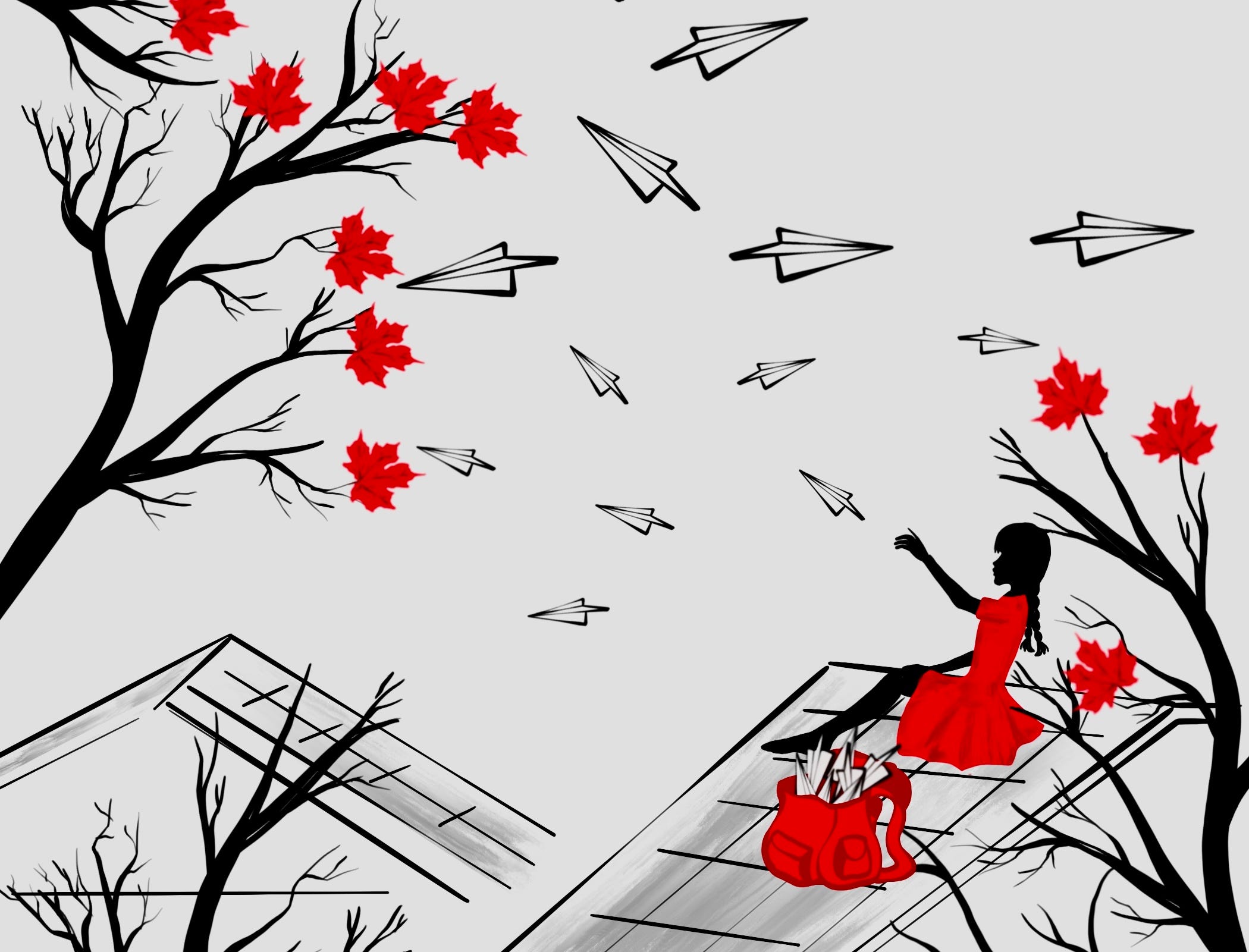
P.S. By the way, since the pieces in Ode to Hope and Despair are written in many different styles and perspectives, keeping them all part of the same book did prove to be a challenge. I was lucky to work with Melissa Sussens as my editor, who approached my book with gentle consideration for its stylistic diversity, while still challenging me softly to try different ways of working with my writing. (The images are also from this book.)
AI disclosure: ChatGPT was leveraged to check grammar/spelling/punctuation and brainstorm title and subtitle ideas.